







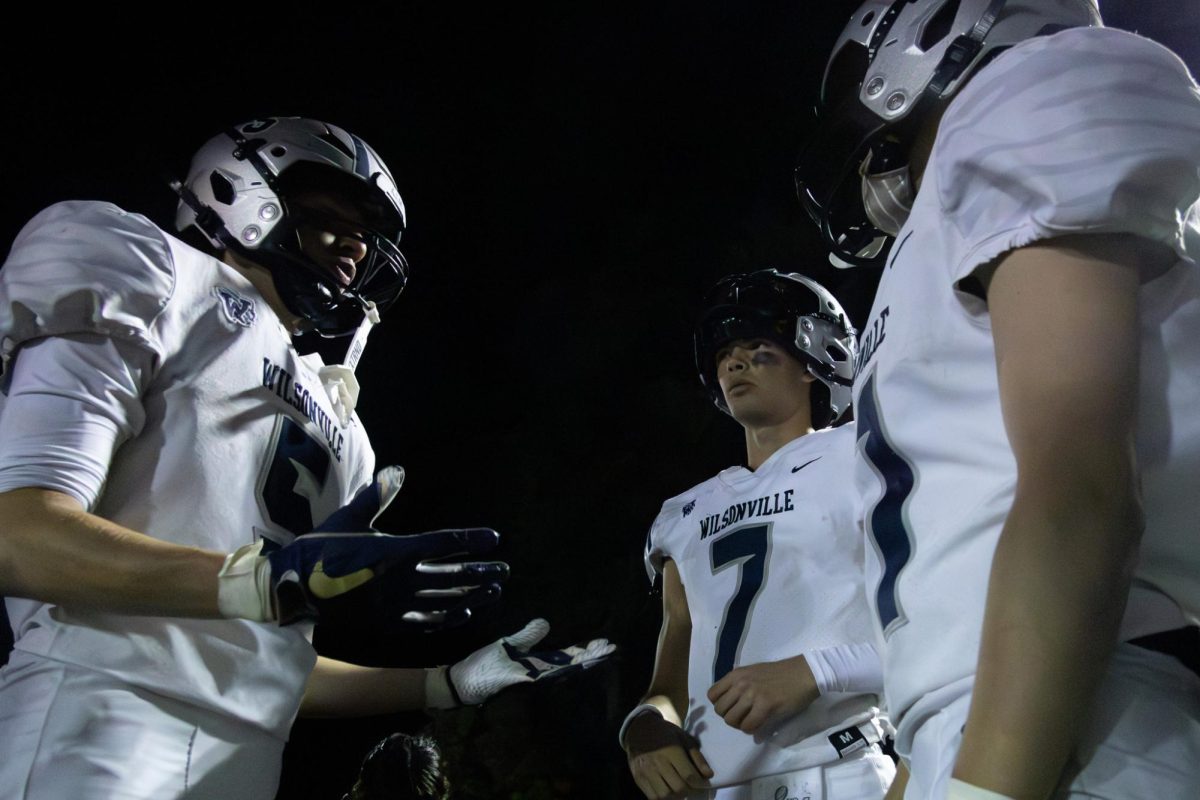
High school rivalries are often framed as harmless traditions—spirited games, packed stands, and a sense of identity forged through competition. At Wilsonville High School, these rivalries have helped shape a strong culture of pride and unity, reinforcing what it means to be a Wildcat. Yet as valuable as competition can be, it also raises an important question: do rivalries genuinely strengthen a school community, or do they risk creating division under the guise of spirit?
This tension is especially relevant as Wilsonville continues to debate a defining issue: should WHS remain a dominant force in the 5A division or move up to 6A, where the school would face tougher opponents and potentially sit closer to the bottom of the standings? Many students see the decision as a symbolic crossroads. Is it better to excel where we are, or challenge ourselves in a more competitive field?
Junior Courtney Gray views rivalry—regardless of division—as a source of school unity. “I think it brings everyone together. For sports games, everyone wants to go to see the turnout. Depending on who wins, you can hold that against them on the Barstool account,” she jokes. For Gray, the energy of rivalry is what fuels the school spirit that Wilsonville prides itself on.
Kaia Massey links that excitement directly to familiar opponents. She cites West Linn as her favorite rival—even though they’re a 6A school—as well as Canby within the league. “Since we share the same district with West Linn and everyone knows everyone…the week before the game, everyone is encouraged to show up. The games are always close, and the student sections are vocal and engaged.”
Whether Wilsonville plays at the top of 5A or steps into 6A, the friendships and connections across districts keep rivalries personal and lively. “It brings the spirit out of everybody,” she adds.
At their best, rivalries provide structure and meaning to school culture. At Wilsonville, they serve as moments where students, staff, families, and alumni come together around a shared identity.
Rivalries also demand excellence. They elevate expectations, sharpen focus, and encourage students—particularly athletes—to perform at their highest level. “Way more energetic—you want to win every point. You’re giving it your all,” Gray says, recalling recent volleyball matches within high-stakes games. These high-pressure moments instill discipline, resilience, and teamwork, qualities that mirror the broader goals of education itself.
And yet, some students question whether rivalry always produces the community-building it promises. Mary Elizabeth, a senior, argues that the language of rivalry can push things over the line. “I find that rivalry between two people creates more conflict than good. Competition can always be good and fun, but using the word ‘rivalry’ can feel kind of personal, rather than team vs. team.”
Her perspective highlights how quickly school spirit can slip into something more divisive. When competition shifts from healthy motivation to hostility, it can undermine the very community it intends to strengthen. Excessive trash talk, disrespect toward opposing students, or a mindset rooted in humiliation rather than excellence erodes the values schools aim to uphold.
For the most part, Wilsonville students continue to uplift all athletes, no matter the score. Athletic director, Mr. Davis, ensures that the competitive environment remains respectful and appropriate. Among the students, though, a sense of accountability is held for each individual to cheer wildly, but joyfully.

Although this perspective is prominent in athletic settings, the idea of “rivalry” carries into all school-related extracurricular/activities. Elizabeth, who recently transferred to WHS, explains that even outside athletics, rivalry can mirror the status quo of social groups.
“Being friends with two kinds of people and split between two groups can be hard because there isn’t much common ground at first glance.” Rivalries, she says, can unintentionally reinforce boundaries. To navigate them, she chooses to “show up to different things,” even when it feels uncomfortable. “Being new, I have to be confident in who I am.”
Still, for her, rivalry is not inherently negative. “It makes me want to rise to do better and treat them with kindness,” she says, framing competition as an opportunity for both personal and academic growth. She loves the challenge, but not the hostility. “We may have this conflict that revolves around school, but it doesn’t have to impact how we respond and interact.”
This balance—between pride and respect, confidence and humility—is at the heart of the rivalry conversation. Even competitive athletes recognize the responsibility that comes with it. “They make me perform better…If I’m playing at a school that I know we have a rivalry at—we’re rivals for a reason,” Courtney says. But she also emphasizes sportsmanship: “I always encourage the other team, even if it’s our rival.”
The challenge for Wilsonville High School is not to eliminate rivalry, but to elevate it. Maturity lies in redefining what it means to compete. Rivalry should be a platform for excellence, not entitlement; a stage for pride, not polarization.
This begins with intentional leadership. Coaches, administrators, and student leaders must consistently reinforce the importance of respect. Celebrating effort as much as outcome—and modeling graciousness in both victory and defeat—sets a standard that students are more likely to follow.
Wilsonville also has the opportunity to broaden the scope of rivalry beyond athletics. Academic and artistic competitions—theater, music, robotics, ISEF—can channel the same energy into spaces that highlight intellectual rigor and creative achievement, fostering a culture where competition coexists with collaboration.

Rivalries remain a powerful element of the high school experience, and at Wilsonville, they play an undeniable role in shaping school identity. But their true value lies not in the intensity of the competition, but in the character it cultivates.
If the school stays in 5A or moves to 6A, the spirit will remain—but so will the responsibility. When grounded in respect, tradition, and shared purpose, rivalry becomes a unifying force—one that strengthens community and encourages growth. When fueled by division, it fractures the culture it was meant to fortify.
For Wilsonville High School, the goal is clear: preserve the passion of competition while prioritizing the dignity of every student. In doing so, the Wildcats can ensure that rivalry does more than define a season—it defines a legacy of enduring pride.