







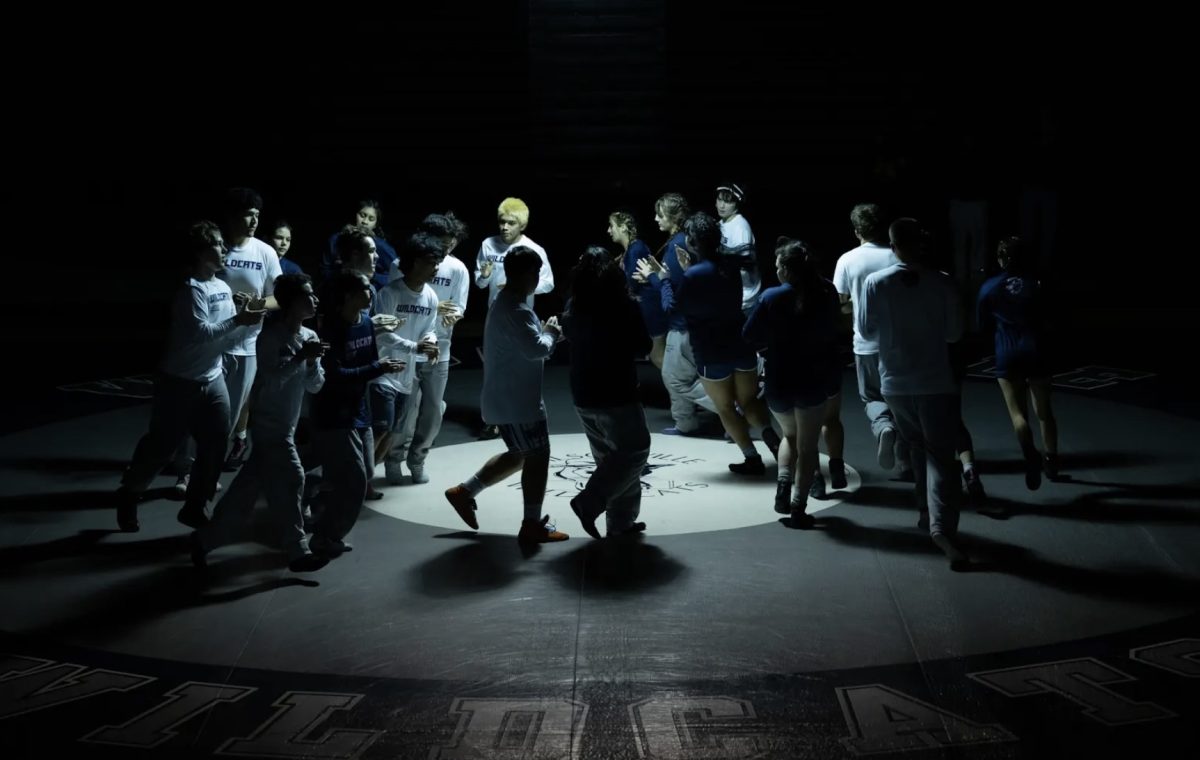
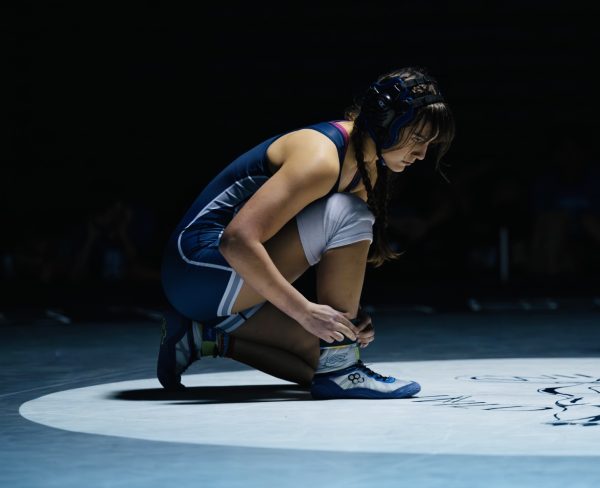
Wrestling begins and ends in a circle. The mat itself is a closed loop—no sidelines to retreat to, no place to hide—just six minutes of truth. Head coach Jason Milham describes it simply, yet poetically, through the team’s mantra: “360. 3 rounds, 6 minutes, 0 excuses.” It is a philosophy that mirrors both the geometry of the mat and the lived reality of the sport. Three periods. Six minutes (360 seconds). Zero room for hesitation. Wrestling, in its purest form, asks athletes to give everything within that circle and trust that effort will eventually be returned.
That belief—that good things come from relentless perseverance—is what turns offense into identity. For wrestler Maleeya Rodenbeck, staying aggressive isn’t just strategy; it’s a disruption. “It helps push back against people who don’t expect it,” she says, “and when they don’t expect it, it’s easier to win.” Aggression forces reaction. It tilts the balance of power. In wrestling, initiative often determines outcome, and confidence is built not by waiting for opportunity, but by creating it.
Yet the real weight of wrestling is not always visible from the stands. Only wrestlers understand the grind that stretches far beyond match time. “All sports have challenges,” Milham reflects, “and it’s kind of apples and oranges.” What sets wrestling apart is its constancy.

“Football players work hard and go in short bursts, but for wrestlers, it’s constant cardio for the whole time on the mat.” There is no pause button, no substitution. Add to that the unrelenting awareness of weight—“Every wrestler is aware of their weight”—and the sport becomes as much mental as physical. Nutrition isn’t optional; it’s a daily calculation, a constant reminder that discipline matters.
The season itself is a test of endurance. Winter mornings begin before sunrise and end long after dark. “Expect 5:30 AM Saturday mornings,” Milham says. “Long Saturdays.” Wrestling is not a single moment of success, but “14 weeks of a grind in season—no excuses.”
And unlike many sports, wrestling offers no buffer between failure and redemption. “You could wrestle the best match of your life, and still walk off having lost to the scoreboard. But those losses must be short lived, because you have to turn around 40 minutes later to do it again.”
Wrestling rooms thrive on shared hardship. “If you’re all going through the tough workouts, the cutting, the good and bad matches, everyone is supporting each other,” Milham explains. The pain is communal, but the perseverance is too.
For some, the mental breaking point comes not during a match, but on a scale. One wrestler recalls her freshman year, when she was asked to make 130 pounds. “I had to cut six pounds in one night. When I woke up the next morning, I was two pounds over.” Exhausted and overwhelmed, she wanted to quit. “I ended up yelling and saying I didn’t want to do it.” But she didn’t walk away. She made weight—and in that moment, the grind transformed into triumph. “My entire team carried me downstairs in celebration.” Wrestling has a way of turning private suffering into shared victory.
For female wrestlers, belonging carries added weight. Walking into the room means claiming space in a sport that is still redefining itself. Milham credits the girls with shaping team culture. “The cohesiveness of our teams—we practice together. Many of our competitions are also together.”
Over time, he’s noticed something deeper. “I think the girls have had that cohesiveness more than the boys over the past couple of years.” Their presence elevates the entire room. “They have a good attitude, are coachable, and this posture carries over to the boys. We feel their absence.” Belonging, then, isn’t granted—it’s earned through effort and consistency. Rodenbeck reflects, “Working hard makes you stick out the most and makes you feel part of the team.”
Support remains constant, even in a sport defined by one-on-one combat. During matches, the mat is never truly empty. “We’ll have the whole team on the side of the match, cheering them on,” Rodenbeck explains. Wins are celebrated, losses examined, growth encouraged. No one wrestles alone, even when the scoreboard says otherwise.
Certain weight classes quietly define a team’s momentum. Middleweights don’t always carry the headlines, but they carry the balance. “The lighter people have big names and big titles,” Rodenbeck admits, mentioning Serena Johnson at 135 pounds. “I get scared when I see her name in the bracket, but I also want to get to the point where I can take her on confidently in a controlled match.” Wrestling teaches athletes to confront fear not by avoiding it, but by preparing to meet it head-on.
For younger wrestlers stepping onto the mat for the first time, the message is simple, if not easy. “If you just started, don’t give up,” Rodenbeck advises. “You walked into the room knowing it’s going to be hard, but listen to your teammates because they’re alongside you.”
Milham frames it in terms of time and sacrifice. “Hard work pays off. You have to play in the long game.” Wrestling, he says, demands payment from everyone. “Everyone in wrestling pays a price. Some paid it in fourth grade… or maybe as a freshman when they first stepped on the mat.” Success is never accidental. “Every champion has paid the price someplace along the way.” The reward, often delayed, is earned through perseverance. “It’s easy to step away when you’re struggling,” he says, “but there’s great value in the struggle.”
That struggle is what keeps wrestling alive, even as other sports fade. Girls wrestling continues to grow, fueled by athletes who step onto the mat not to prove they belong, but because they already know they do. Wrestling has survived thousands of years because it reveals something timeless: character under pressure.
Inside that 360-degree circle, effort is honest, outcomes are earned, and perseverance is claimed. These athletes are not here to ask for permission. They are here to compete, to endure, and to win—carrying the oldest sport in the world forward, one hard-fought match at a time.